Intro

Welcome to my blog! This is a site where you can keep up to date on my life as a full-time athlete in the sport of cross country skiing. You can expect regular updates throughout the year as I report on training, racing, life in general and maybe even some school. Sponsors, family, friends and fans: Enjoy!

Wednesday, October 24, 2012

Visiting an extraordinary athlete in the high country

Last year I had big plans of training at high altitude a few times during the year, both in Whistler and down at my friend Marshall's place in Colorado. Both plans were quelled with a mononucleosis diagnosis last August (you have to wait until August for the snow to melt on the mountains around Whistler). This year I wanted to put my previous plans into action. All of the top cross country skiers spend bouts at altitude throughout the year. With that, I bought a $60 unlimited gondola-use hiking pass for Whistler, and contacted my buddy Marshall Ulrich, who I met as a youth ambassador on impossible2Possible's inaugural youth expedition to Baffin Island in 2009 when he was an inspirational ambassador and guide on the trip. Being more than accommodating to my ambitions for an altitude camp this fall, Marshall invited me to make his home, nestled high in the mountains above Idaho Springs, Co, my training base for a few weeks this October. 

Marshall and his wife are some of a small handful of folks who live above 3000 meters of elevation here in North America. The altitude allows for easy acclimation for Marshall's mountaineering trips and offers great training for Marshall's ultrarunning. For me, the high altitude was a stress on the body simply sitting on the couch, not to mention how it reduced some training sessions to feeble, gasping carcass drags. Luckily, I had the option of training down at 2300 meters, which over the course of my two weeks at Marshall's came to feel "low" despite being a vertical kilometre higher than Canmore, AB, a place where I normally struggle with the thin air. During the final 4 days of my stay, I finally noticed a change in my hemoglobin's oxygen saturation levels. At rest, it finally jumped up from 90 to 94%. Training session sensations never truly improved.

My gracious host for the week, the indomitable Marshall Ulrich (his wife, Heather, is also gracious and indomitable). Marshall's feats of endurance are truly mind boggling. Just look him up on Wikipedia. 

Scouting up in the high country for biking and running routes. The Ulrich's place has easy access to running terrain above 3500 meters, as well as some of Colorado's fabled 14,000'ers (alas, a nagging knee problem inhibited me from summiting one)

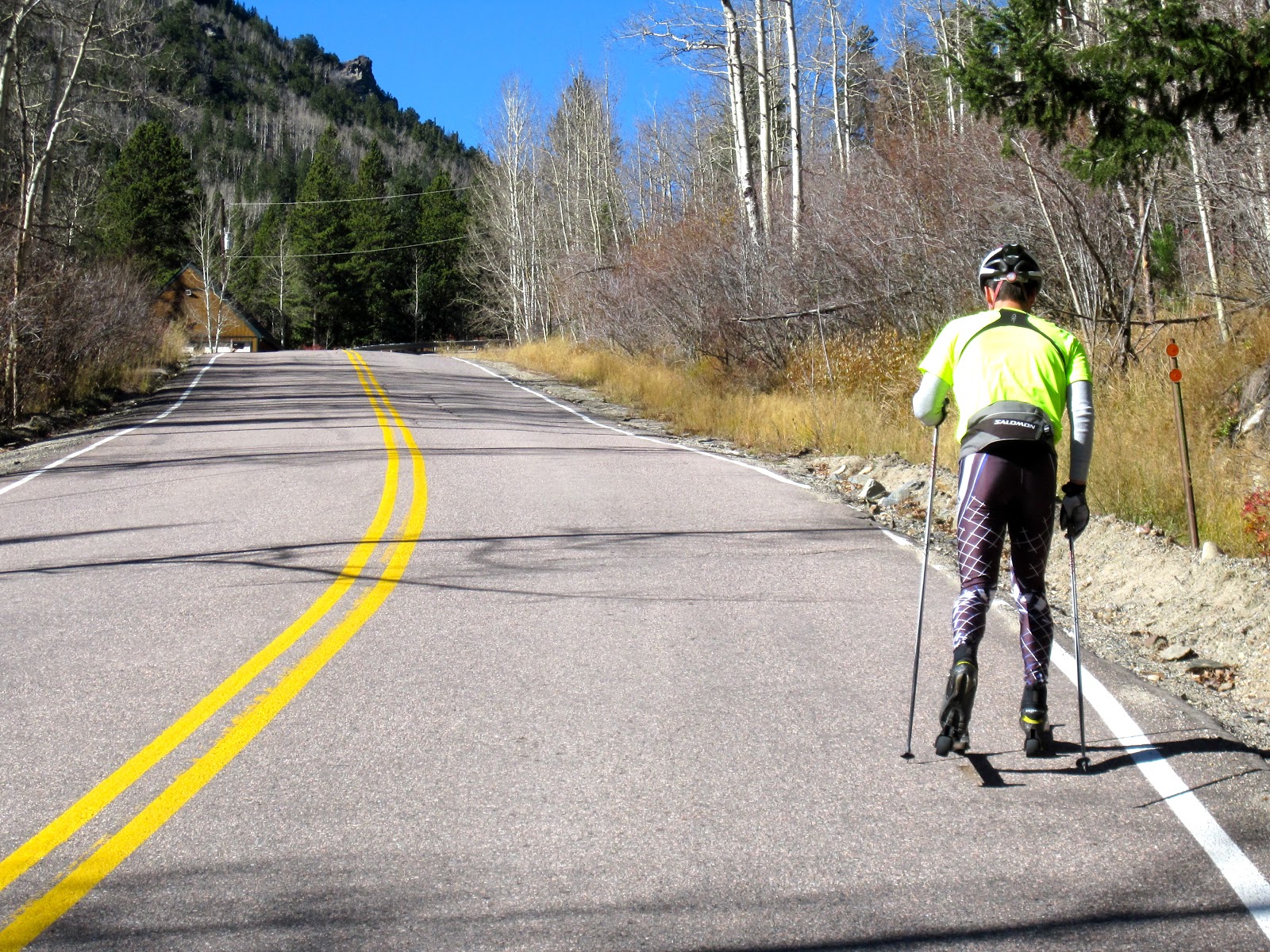
Many of my days were spent toiling up the 15 km, 800 m vertical Fall River Road that leads up to the Ulrich's. Some pitches are 16%!

I swear I didn't photoshop this. A looming storm front moves in over Lake Quivara, up by St. Mary's Glacier.

Very characteristic fall Colorado colours. Browns and dark greens. This is just up above Marshall's place. The lake is fed by the meager snow patch that is St. Mary's Glacier (out of frame). 

Am I happy that I completed this stint of altitude down in Colorado? Part of me says yes: it was a great opportunity to visit some beautiful states on my 3,000 km drive down there, and to get to know Marshall and his family. But at the same time, I experienced solitude and loneliness on the 5-day drive down to Colorado, camping and roughing it every night. And even though the training down there was very good and challenging due to the somewhat extreme altitude, I am not yet noticing any huge changes in how training feels. I guess that comes after this next period of hard, intense work. The increased hemoglobin mass and other improved parameters will shorten recovery time after hard sessions and will help me maximize the higher intensity training of the coming weeks. Any gains will take a bit of time to materialize and present themselves. Racing season is a little over a month away. The gains should be showing by then. Keep the nose to the grindstone...

T


Friday, October 5, 2012

Driving to Colorado: A 5-day test of mental fortitude

At the moment I am sitting in a quaint café at 2200 meters elevation in Idaho Springs, Colorado, watching as the lingering remnants of last night's snowfall melt away, reminiscing on the punishing feat of endurance that brought me to this faraway land. Over the course of the 3,000 km driving journey from Whistler to Idaho Springs, I have come to appreciate the incredible natural beauty that the varying USA landscapes have to offer (and I haven't even seen the half of it!). At the same time, this quest of discovery has been fraught with anxiety, as I attempted to cope with the constant mental alertness of driving all day long, and of being resourceful enough to screech into my day's destination and trying to nail down a suitable place to pitch my tent in the waning light of the autumn days (sometimes it was even downright dark).

One night, after I found out that my desired campsite in Yellowstone was closed for the year, I camped on a forest service road on the edge of the park right next to where two wildlife officers and their dog had just driven away with an occupied live-grizzly bear trap in tow. I slept about 3 hours that night as every perceptible sound and shadow materialized into an imaginary bear circling my tent.

From where I camped in the hills beyond the mouth of this valley I could make out this white hillside, that upon closer inspection were hot spring terraces. The sound of elk calls and the first rays of sunlight striking the Mammoth hot springs marked the beginning of my prehistoric foray into the supervolcano that is Yellowstone National Park.


This sight could almost be in the Northwest Territories, besides the fact that this male is a plains bison, dwarfed by the 2,000+ lb. wood bison subspecies of the NWT, whose heft equals or exceeds that of my Honda Fit. 

The primordial geothermal activity of the park instilled a true sense of wonder.

Rising steam venting from geysers and hot springs are everywhere within the caldera.

The heat generated from all of this geothermal activities greatly aids the large herbivores in the park during their winter forage in the harsh high altitude climate.

After spending a night in Park City, UT, I got to roller ski at the 2002 Olympic Venue of Soldier Hollow. It was inspiring remembering the last generation of stars who duked it out on these very trails back in the day when I was just starting to really get into skiing. The likes of Beckie Scott, Thomas Alsgaard, Per Elofsson, Johann Muehlegg (convicted doper), etc... It was also very nice to catch up with some friends on the National xc and biathlon teams who were on-site, after the solitude and loneliness of the first few days of road trip.

Unbelievably fast and flowy single track in Vernal, Utah. The guys at the bike shop laughed at my 26" wheel mountain bike. I guess in this part of the world 29ers rule supreme, and in fact, that's all they had at the shop. When I asked if they had any 26" bikes at all, the ex-world champ bike shop owner laughed and says, "yeah, we have a few. But they're kids bikes!"


My second night camping in Utah, I was in Dinosaur National Monument. I enjoyed a balmy evening and an incredible sunset amidst prancing, tularaemia-infected rabbits at the campsite on the banks of the Green River. As I slipped into my sleeping bag, the peaceful and calm evening was broken as a light breeze picked up. Before long, this breeze had manifested into 100 km/h gusts of wind that would scream through the river canyon before they blasted your tent and threatened to carry you off across the desert. I can sleep in a tent when it is windy outside, but gusty is another matter. The intermittent gusts would be separated by periods of complete calm, usually lasting about a minute, before the cool mountain air from Colorado would plunge into the river valley and build up into another howling, canyon-scouring gale that you would hear coming from miles away. My tent and I survived the night, but my beauty sleep did not.


The next day I got to revisit a childhood passion of mine: palaeontology. In a school project in grade 6, I was required to write down my life ambitions. When I grew up I wanted to be a professional skier and upon retirement from that I wanted to be a palaeontologist. It is neat that I am now pursuing skiing as a profession, while at the same time maintaining my childhood fascination of dinosaurs and having a bucket list objective of spending time working at a dino dig in some far-flung location sometime in the near future. At Dinosaur National Monument they have a cool glassed in quarry where you can observe a fossil "logjam" caused by dino carcasses being washed downstream as rains return after a period of drought. The logjam consists of only large dinosaurs that would be swept away and piled along certain sections of riverbed, while the smaller dinosaur remains would be crushed and destroyed by the turbulent waters.

Running "Sound of Silence" trail in Dinosaur. All you would hear amongst the huge slick rock formations was the eerie echo of your footsteps.

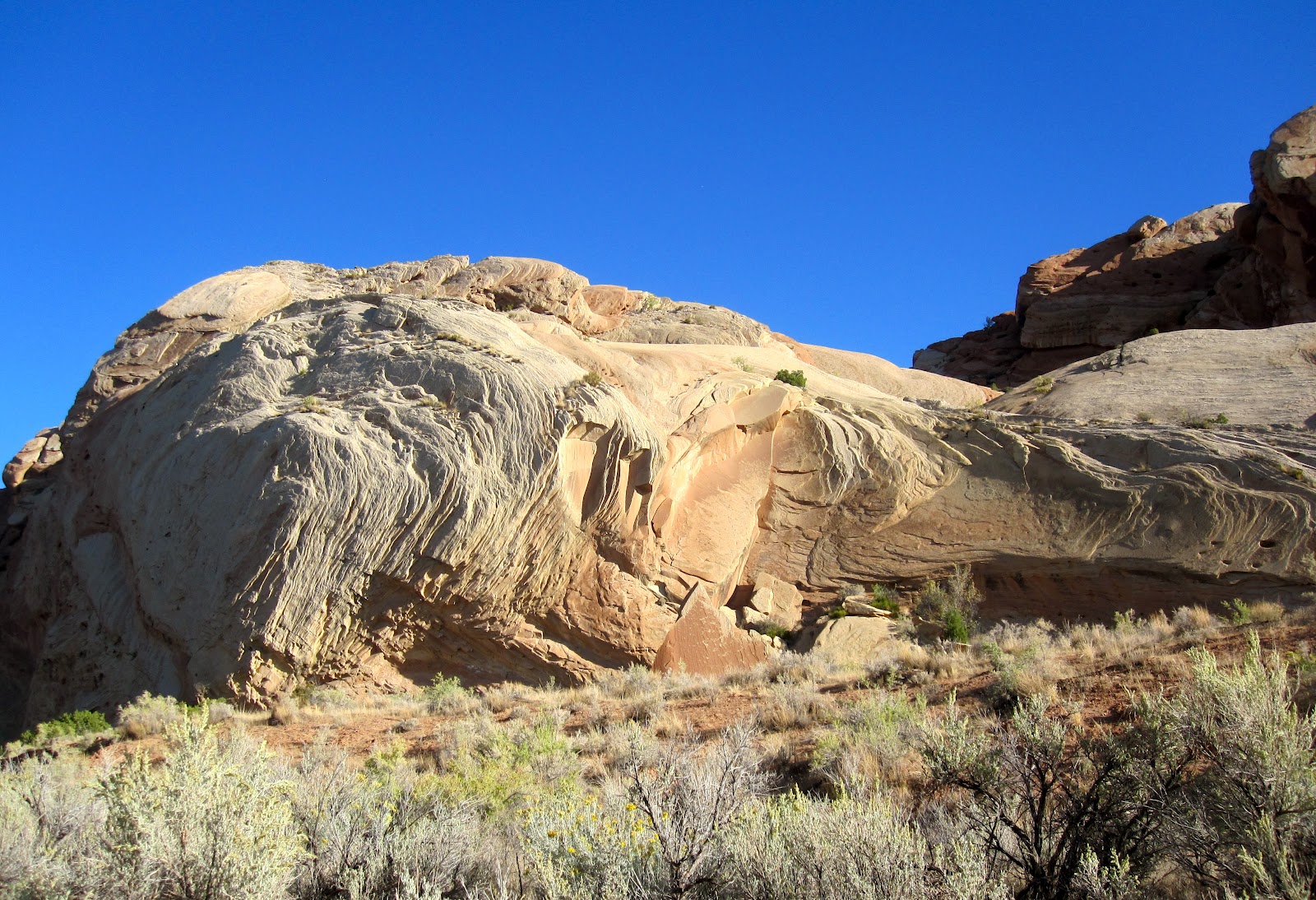
Rock formation along "Sound of Silence". 

A mouthwatering field of "ribeye from the sky" in Utah. (Sandhill crane.)

Today I am waiting to meet up with my buddy Marshall "Endurance King" Ulrich, who will be putting me up in his home for the coming weeks of my high altitude dry land training camp. I know Marshall from the impossible2Possible Baffin Island expedition that I was on in 2009. Marshall's exploits include running 3,063 miles across the USA in 52 days at the age of 57, as well as being the first to run a non-stop 584-mile Badwater Quad (twice back and forth from the below sea-level elevation of Death Valley to the top of Mount Whitney at 14,505 ft, the highest point in the contiguous USA). I shouldn't complain too much about my 3,000 km drive across the states...

After my night in a motel in Idaho Springs. Supposed to be rather wintery while I am here. Meanwhile, Whistler continues to enjoy it's best fall in over 30 years (according to long-time local-extraordinaire, Boyd McTavish) with constant bluebird and daily highs of over 20 degrees.

The next few days will include regaining my bearings after the mentally taxing driving. I will enjoy some moderate training as I explore the environs and acclimatize to the unprecedented high altitude. The scenery is much different in Colorado compared to the other states I have experienced on this trip. The scale is much more grand. The colours are dark green and brown and the mountains are bigger. And it is much colder.

Stay tuned for another camp update...

T

Tuesday, September 18, 2012

Huckleberry Festival

This year's Huckleberry Festival at Callaghan Country Lodge was a bountiful and unseasonably hot event. The weather was much improved from last year's trudge through a torrential downpour (the sad day that my 6 year old cell phone died) and the huckleberries were in no short supply, a stark contrast to last year's nonexistence. 
Antoine is all smiles with the return of the huckleberries as we hike up to one of our favourite places in the world. 

The hardy crew from last year's soggy Huckleberry Festival. This year there were an additional 30-40 people!

The 4.5 km hike took us a full 3 hours as we foraged and grazed on berries at every opportunity.


The Callaghan Country Lodge (there wasn't actually snow up there. The only shot I have of the lodge is from winter...)

Once at the lodge, chefs Kristy and Evan transformed our berry harvest into pancakes...

...and pies.

Hilarious quote from random dude: "I just thought we were hiking up to some lake, then next thing I know I am sitting in a sweat lodge up in a tree fort!"
Enjoying the final hours of daylight after a glorious fall day in the Callaghan Valley.

Some still hadn't had their fill of huckleberries...

Kajsa even found a King Bolete mushroom! Boletes are an edible variety, pointed out to us by fellow hiker and photographer extraordinaire, Joern, whom we found deep in the woods, stalking us with his camera lens.

Until next time...

Friday, August 24, 2012

To endure you must push and glide

My annual pilgrimage (with the exception of last year) to the Haig Glacier near Canmore, AB, is one of the only times in the year that I am totally unplugged from my computer and cell phone. It is a short span of days that is uncomfortable for some; to be away from the comfort of home and their bed and the services and entertainment of society. For me, it's a respite from the bustle of modern living. It is a time when the main activities of an athlete are emphasized to the max. Namely: sleeping, eating, training and socializing. To be high above the tree-line in the heart of the rocky mountains adds a sense of remote wonder that brings into focus these key, monastic elements of the athlete lifestyle.

The training days are hard, and start early so as to take advantage of a firm ski track after the overnight freeze. A big training day at the Haig consists of 45 minutes of hiking uphill to the ski track on the glacier. Then there can be up to 3.5 hours of skiing; some classic, some skating. This is followed by a 20 minute hike back to base camp. The afternoon may hold an additional hour of strength exercises or mountain running. All told you are looking at up to approximately 5 hours on the big days. To make matters more challenging, it could be pouring rain all day, or sleeting, or snowing. With a limited wardrobe due to helicopter flight weight restrictions, every shred of ski clothing will soon be drenched on these inclement weather days. To be at the mercy of quickly changing weather conditions adds to the sense of respect for the desolate, yet beautiful, landscape. The one saving grace for these long, cold days is that you are constantly in motion; pushing and gliding and mentally repeating technical cues; your body pulsing with heat from the exertion to fend off the cold. To be worn down by the weather cultivates a sense of appreciation for the training – to endure you must push and glide.

When the weather is nice, the training experience can be pure bliss. The hot reflection off the glacial snow paired with the stillness of the summer mountain air makes for a truly enjoyable experience. Clothing remains dry and skin takes on a healthy glow.

The return to base camp marks the end of the day’s primary training, and the start of gluttony. To throw down big training days and to log 20-25 hours in the week takes a considerable calorie count, especially at the high altitude. Food is in no short supply, as the glacier hosts prepare seemingly endless meals. You soon gain a perpetual sense of bloated contentedness.

The resultant mid-day food coma generally puts athletes under for 1-2 hours of nap time (3+ hours for the completely shattered). Reemerging from the dark sleeping quarters of the upturned half-culvert quasi-geodesic huts, delirium sets in as ones eyes adjust to the bright, bleak moonscape. Snacks and sloth are the chief activities of the afternoon, sometimes rudely interrupted by a run/hike or a strength workout.  After the voracious feeding frenzy that is dinner, final chores are completed, and board game hullabaloo commences (this year’s ever-popular Settlers of Catan had emotions running high, to the detriment of some).

This Haig update is new to some, but I have in fact been back in Whistler for exactly one month after my stint out in Canmore. As much as Canmore is skiing central and has some of the best training in Canada, Whistler in August is simply the cat’s meow. Sun and heat and a plethora of beaches to satisfy the aquatic desires of those young and old, those clothed and those not clothed (there is in fact a nude beach in Whistler). And high up in the alpine the snow has finally receded enough to allow for high altitude hikes and runs.

On the training front, things have been going well. Personal bests are being shattered and milestones achieved. But the days are getting shorter. Yesterday Whistler mountain had it’s first snow storm. Winter is coming. (I feel okay saying that since I come from the modern day Winterfell of Yellowknife, for all you snickering Game of Throne fans.)

 
In this shot I am the only one holding out still wearing a shirt under the hot sun.
photo cred: Chris Manhard

A not so nice day of rain and fog.
photo cred: Chris Manhard

Lots of snow left in the alpine meant an easy boot ski home for lunch after a morning of skiing. 


4 weeks ago I skied the CVTC's skate time trial course in hard intervals of 3:00, 3:00, 3:00, 2:40, 1:30, 1:30 for a total of 14:40. Two days ago I skied the TT in 14:56, under the 15 minute mark that I thought would be pretty tough to break. Things are on track. 

En route to a good time trial yesterday, I employed a few mental strategies recently learned from reading Tim Noakes' "Lore of Running". An incredible read for all athletes, not just runners. Some good insight from some great minds about what limits race performance.

Thursday, July 19, 2012

4 year anniversary of Diamond Sponsor, Stantec Inc.!

Previously FSC Architects & Engineers, but acquired by Stantec Inc. in fall 2011, has been my largest sponsor from the North over the last 4 years, sponsoring me at my highest level of sponsorship, the Diamond Level.


From Google:


"Stantec Inc. (Stantec) provides professional consulting services in the area of infrastructure and facilities for clients in the public and private sectors. The Company’s services include planning, engineering, architecture, interior design, landscape architecture, surveying, project management, environmental sciences, and project economics for infrastructure and facilities projects."


Stantec's corporate philanthropic stewardship of athletics in the North is second to none, sponsoring other high level athletes such as my close friend and snowboarder, Andrew Matthews of Yellowknife (who also trains in Whistler and is my next-door neighbour!), and other high level cross country skiers, the Nishikawa siblings, from Whitehorse, YT. 


Presenting a traditional Inuit whale bone carving of a skier to Warren McLeod of FSC Architects & Engineers in Yellowknife (now Stantec). The carving is mounted on a large, flat slab of sandstone collected from a rocky beach on the breathtaking East Arm of Great Slave Lake, my summer vacation spot from childhood and a place that is very close to my heart. 
The piece of whale bone was carved into a likeness of me skiing by my childhood soccer teacher and long-time friend, Bob Kussy of Ashoona Studios in Yellowknife.


Thank you, Stantec, for your continued support in my ski career. Without your help this wouldn't be possible.


Thomsen


Wednesday, July 11, 2012

New Sponsor: Manitoba Harvest


It is with great pleasure that I announce my partnership with Manitoba Harvest Hemp Food & Oils. The company is committed to athletic excellence and is the first company to produce a dissolvable hemp protein powder (Hemp Pro 70), a great substitute for those of us who can't digest milk protein powders well. 

Hemp is hailed as a super food due to its excellent amino acid profile, high mineral and vitamin content, and it's abundance in omega-3 and rare omega-6 GLA fatty acids. I have supplemented hemp to my daily diet with great success in the last two months. Hemp Hearts are a simple and effective addition to breakfast cereal (as well as salads) and hemp products have turned me into a smoothie enthusiast. 

My favourite smoothie recipe:

- ripe banana
- 4 locally grown strawberries (they are red right through and taste way better)
- 3 dates
- 3 heaping tablespoons of Manitoba Harvest hemp hearts
- 3 tbsp Manitoba Harvest Hemp Pro 70 protein powder
- kale or spinach (to taste)
- plain yogurt
- generous helping of cinnamon
- splash of fruit juice
- squirt of Manitoba Harvest hemp oil


The hemp products give the smoothie a nice green nutty flavour. A huge bonus for me with the hemp protein powder, is that it is much easier for me to digest compared to various milk protein powders that I have tried. I have said goodbye to bloating and cramping post-smoothie. 


Thanks Manitoba Harvest!

Tuesday, June 19, 2012

A year in review (with a lot of point form)

This update should have been up about two months ago, so I have combined an update to bring you up to speed along with a brief recap of last year.

2011-2012 in a few words:

The year that I...

- got an iPhone (and consequently had my life changed)
- had laser eye surgery
- read a record of approximately 30 books (due to improved vision from eye surgery you ask? Perhaps)
- caught mononucleosis
- moved where I was living 4 times
- fended for myself for training and racing plans to a large extent after being cut from my previous ski team despite having a really good season in 2010-2011.

As you may guess from the points mentioned above, there were a few frustrating aspects to this past season.
NorAm action in Canmore, AB, sprint qualifying with the sun rising.

That being said, there were also a few very encouraging aspects to the year. Namely, being 4th Canadian in a NorAm classic sprint qualifier and a 14th place Canadian in a 15 km skate at Nationals. As the season progressed, the toll exacted from the mono made itself evident. I lacked the solid base of summer training that carries athletes through the winter months of racing. I was, however, proud with the consistency I was able to achieve by taking a week-to-week approach to training throughout the winter as energy levels fluctuated dramatically like the tides in the Bay of Fundy. Although I did not race as well as I would have liked to at as many races as I would have liked to race well at, it was another year to chalk up to experience.
Enjoying a weekend of sun in the Indian Arm (not the Bay of Fundy) near Vancouver in August, 2011. (This was shortly after my mono diagnosis. Thanks to Logan who paddled me around for 40 km)


While afflicted with mono in the fall, I took a trip home to Yellowknife. No better time to visit parents than when you are lamed up in bed! My visit coincided with the Yellowknife Ski Club dedicating a trail section to my dear friend John who passed away in 2010 in a tragic helicopter accident. 

A time trial in early winter 2011 in Whistler. A testing grounds for my return to racing. 

Much time was spent throughout the year at the Heyes' cabin near Princeton. This past winter I had the pleasure of meeting Nat Brown, who has been involved with the ski program in the States for many years and who resides part-time in an ancient shack near Princeton and maintains 7.5 km of meandering ski trails on his acreage. 


So what have I been up to so far this year?

- Good April of training in Whistler with lots of ski touring and even a few 3 hr mountain bike rides
- Visited Yellowknife in May to go spring hunting for geese and to seek out sponsors for the year, plus spring skiing on Great Slave Lake
- First ski race of the year (or is it last ski race of the year?) at Mt. Baker Ski to Sea.
- Week of groomed skiing at Whistler Olympic Park into the first week of June
- Landed a fantastic job supervising the Canadian Sports Centre Pacific gym here in Whistler (right next door to where I live)
- Moved into a new town home directly beside where I was previously living.

Another year, another summer of adventure and heavy training hours. There is a lot to look forward to this year, as I am yet again associated with my old team of the CVTC, although am not technically an official member. Thanks to my sponsors for their continued support!

Getting high. An excellent day of touring with Stef and Colin up above Whistler Olympic Park. 

The last race of the year? Or the first? Mt. Baker Ski to Sea race (I am in blue). 

On the hunt. The weathered veteran hunters who have been coming to this same place for over 20 years kept on about how weird this spring's migration was. The migration of goose species was reversed. The late, tougher to shoot birds (high flying snow geese) were first, and the early, easier to shoot birds had yet to come. We even shot a super-rare Eurasian wigeon/mallard hybrid to make it even weirder (at the time my dad thought we had discovered a new species, a duck-chimera of sorts belched forth from a tailings pond in Ft. McMurray to wreak havoc on classification and on ornithologists the world over). We even got thunder stormed on during this 2nd week of May...perhaps a 100 year event that is normally reserved for summer days in July and August. Changing times we live in...